The short answer
A driver settlement statement is the pay record that shows a driver what they earned, what was taken out and what was paid for a pay period. It matters for trucking payroll because your payroll, your books and your tax return are all built on it.
Every load a driver hauls ends up as a number on a pay record. For a trucking company, the driver settlement statement is the document that shows that number to the driver, line by line. It is also the starting point for your payroll, your bookkeeping and your tax return.
This article explains what the statement is, who uses it and why it matters for a California trucking company. It also lays out what Sacramento IRP & Trucking Compliance does in this area and where our work stops.
What is a driver settlement statement?
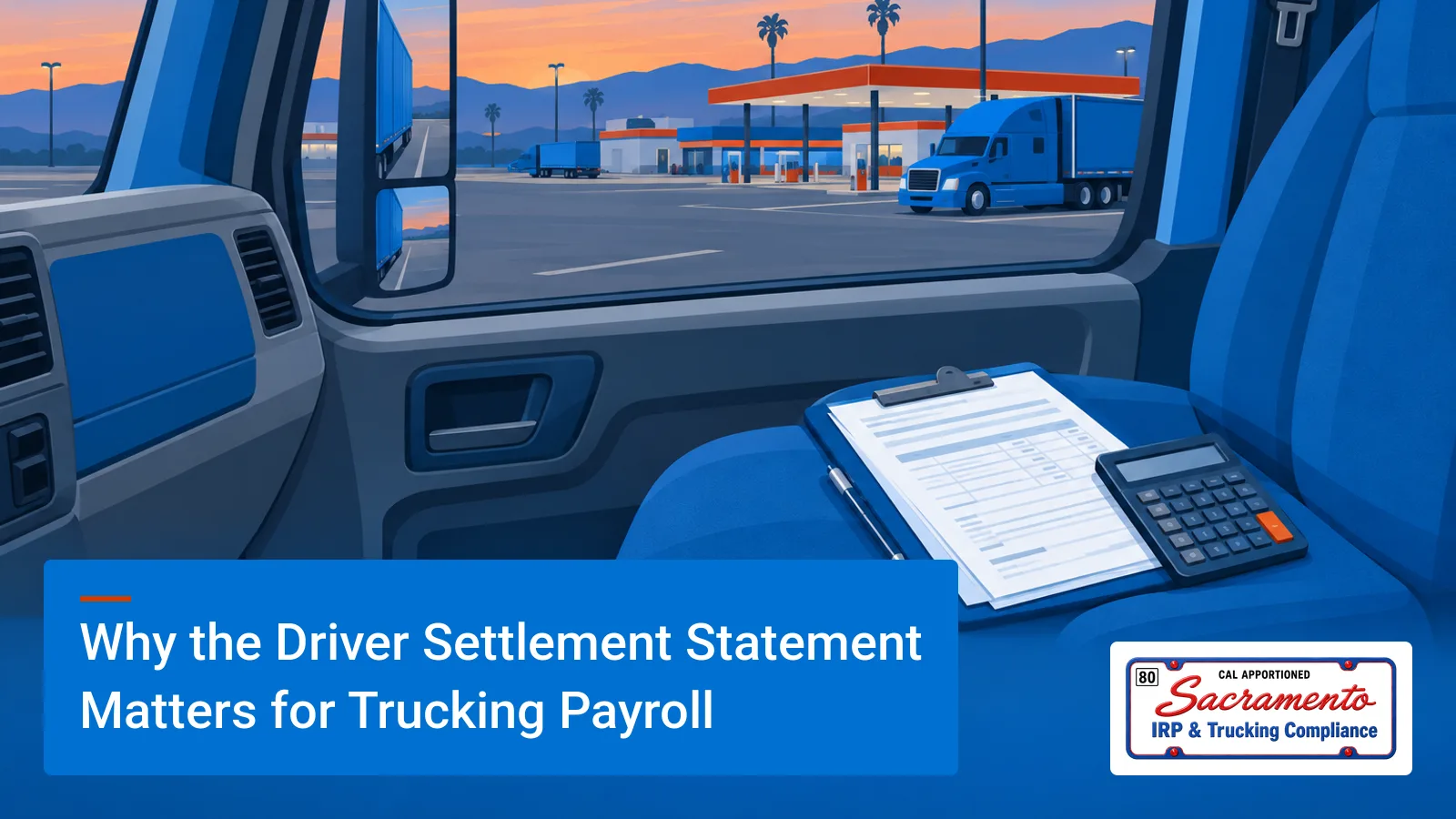
A driver settlement statement is the pay record a trucking company gives a driver at the end of a pay period, showing what the driver earned for the work, what was taken out and what was paid, so both sides can see how the final amount was reached.
It is a business document between you and your driver. It is not a filing with a government agency. The statement lays out the math behind the payment so the driver can follow it from the work to the final number.
The word “settlement” also shows up in federal enforcement, which can cause confusion. The Federal Motor Carrier Safety Administration (FMCSA) uses “settlement agreement” to describe one way a penalty case can close. That has nothing to do with paying your drivers.
| Driver settlement statement | FMCSA settlement agreement | |
|---|---|---|
| What it is | A pay record for one pay period | One of three ways an FMCSA enforcement case can close |
| Who it is between | Your company and your driver | Your company and FMCSA |
| What starts it | A pay period ending | A Notice of Claim (NOC) from FMCSA |
| Other ways it ends | Not applicable | Paying the penalty in full, or defaulting on the NOC, after which a Final Agency Order is issued |
Who needs a driver settlement statement?
Any California trucking company that pays drivers, from an owner-operator with one hired driver to a larger fleet, has a practical reason to keep a clear driver settlement statement for each payment, because it is the record that shows the driver, and anyone reviewing your books later, how the pay was figured.
This article does not say what a pay record must legally contain. Those rules depend on the facts of each business. We do not give legal advice or worker-classification advice, and questions about either belong with your attorney.
Small companies are a big part of this industry. At a 2013 hearing of the U.S. House Committee on Small Business, members described the trucking industry as dominated by small businesses. In a company with a handful of trucks, the owner may be the same person who answers when a driver questions a check.
That is where a clear statement earns its keep. It gives you a written record to point to. It gives the driver a written record to check.
Why does the driver settlement statement matter for trucking payroll?
The driver settlement statement matters for trucking payroll because it is the source record that payroll, bookkeeping and tax returns all build on, so when it is clear and correct the driver can see how pay was figured and your books can match what actually left your bank account.
Think of it as the first link in a chain. Payroll uses the statement to pay the driver. Bookkeeping uses payroll to record your costs. Your tax return draws on your books. A mistake at the first link can travel all the way down.
Federal work rules also feed into pay. Hours of Service (HOS) rules from FMCSA set limits on how long drivers can drive and work. At the same 2013 House hearing, members and witnesses discussed how a revised HOS restart rule changed drivers’ schedules and, in their view, their pay.
When hours shift, pay can shift with them. The settlement statement is where the driver sees that change. A statement that shows the math plainly leaves less room for a dispute later.
What did FMCSA decide about California meal and rest breaks?
FMCSA granted petitions finding that California’s Meal and Rest Break (MRB) rules are preempted under federal law, 49 U.S.C. § 31141, as applied to drivers of property-carrying commercial motor vehicles who are covered by FMCSA’s Hours of Service regulations, with the stated goal of uniform rules in and out of California.
FMCSA’s Office of the Chief Counsel also issued a legal opinion on how that decision applies to lawsuits. In FMCSA’s view, once it issues a preemption decision, the preempted state rule may not be enforced as to the activity or people the decision covers. FMCSA also stated that courts may not grant relief under the preempted rule after the decision, no matter when the conduct happened or when the lawsuit was filed.
This connects to pay records because break rules can affect how a driver’s working time is counted. The determination covers property-carrying drivers subject to HOS. It does not speak to drivers outside that group. How it applies to your own drivers is a question for your attorney, and we do not give legal advice on it.
What happens if driver pay records go wrong?
When driver pay records go wrong, the damage spreads past one paycheck, because the driver may dispute the payment, your bookkeeping stops matching your bank and your tax return ends up resting on numbers nobody can back up, and fixing it later means rebuilding every record that came after the mistake.
There is also the question of outside reviews. FMCSA is responsible for making sure truck, bus and motorcoach companies follow the Federal Motor Carrier Safety Regulations (FMCSR). Its enforcement cases start after compliance reviews, complaint investigations, terminal audits, roadside inspections or other investigations.
Those reviews focus on safety rules, and pay records are a separate matter. Still, records kept in one organized place are easier to pull up for any review than records scattered across shoeboxes and text messages. Clean pay records also make your bookkeeping and tax work easier to stand behind.
What does Sacramento IRP do for driver settlement statements?
Sacramento IRP offers payroll and bookkeeping for California trucking companies as services sold separately and quoted on request, and our Federally Licensed Enrolled Agent prepares tax returns, so the numbers from your driver pay records, your books and your returns stay with one team instead of three.
Here is what each piece covers:
- Payroll. Our trucking payroll service works from your driver pay records so each payment has a clear line back to the work behind it.
- Bookkeeping. Our trucking bookkeeping service records those payroll costs so your books can match your bank.
- Tax returns. Our trucking tax services are prepared by our Federally Licensed Enrolled Agent, working from the same books.
You can see how these three fit together on our trucking taxes, bookkeeping and payroll page.
We are also clear about where our work stops. We do not decide whether your drivers are employees or contractors. We do not represent you before any government agency. We do not pay taxes or government fees from our company funds. Government fees are never part of our plan price. We pass them through at actual cost, itemized separately, and we notify you before we charge them.
Clients also get the Sac IRP Mobile App. It keeps all of your documents, permits and information in one place, on any phone, tablet or computer. Your registration paperwork and your business records sit side by side instead of in different drawers.
Our core work is California truck registration and compliance, and payroll, bookkeeping and tax preparation are added services for the same trucking clients.
Licensed by the California Department of Motor Vehicles as a Registration Service.
What should you look for in a trucking payroll service?
A good trucking payroll service for a California carrier ties payroll to bookkeeping and tax work, keeps records you can reach when a driver or lender asks for them and is clear about what it does not do, such as legal advice or worker-classification advice.
A few things to ask about:
- Trucking focus. The service should understand how trucking pay is built and be able to read a settlement statement the way your drivers do.
- Connected records. Payroll, bookkeeping and tax returns should come from the same numbers, not three separate versions.
- Clear limits. A good service tells you up front what it will not do, so you know which questions go to your attorney.
- Records you can reach. You should be able to pull up your documents from your phone when a driver, lender or reviewer asks for them.
See our trucking compliance plans from $99/month to find the right fit for your company.
Quick answers
Frequently asked questions
What is a driver settlement statement?
It is the pay record a trucking company gives a driver for a pay period. It shows what the driver earned, what was taken out and what was paid. It is a business document between you and your driver, not a filing with a government agency.
Is a driver settlement statement the same as an FMCSA settlement agreement?
No. A settlement agreement is one of three ways a Federal Motor Carrier Safety Administration enforcement case can close after a Notice of Claim. A driver settlement statement is a pay record between your company and your driver.
Why does the settlement statement matter for payroll?
It is the source record for everything after it. Payroll pays the driver from it, bookkeeping records the cost and your tax return draws on your books. A mistake on the statement can carry into every one of those records.
Does Sacramento IRP decide whether my drivers are employees or contractors?
No. We do not give worker-classification advice or legal advice. Questions about how your drivers are classified, or what your pay records must legally contain, belong with your attorney. Our payroll and bookkeeping services are sold separately and quoted on request.
Check it yourself
Sources
Rules and fees change. Confirm anything time-sensitive with the agency before you file.
- Federal Motor Carrier Safety Administration, Civil Penalties and SettlementFederal agency(opens in a new tab)
- Federal Motor Carrier Safety Administration, FMCSA Grants Petitions to Ensure Safe and Uniform Rest Rules in California for Truck DriversFederal agency(opens in a new tab)
- U.S. Government Publishing Office, congressional hearing transcript: Wrong Way: The Impact of FMCSA’s Hours of Service Regulation on Small Businesses (House Committee on Small Business, 2013; context only)Federal regulation(opens in a new tab)
About the writer
Sacramento IRP & Trucking Compliance team
Licensed Registration Service · Federally Licensed Enrolled Agent
Sacramento IRP & Trucking Compliance files IRP, IFTA, UCR and MCS-150 paperwork for trucking companies throughout California. We write from the filings we prepare every week, and we update each guide when a rule or a fee changes.